

Our Week in Vintage: A Village Boot Sale, a Red Anglepoise and the Parrots That Got Away
Hello, hello — and welcome to Our Week in Vintage, my little weekly roundup of what Brad and I have been up to: what we've found, what we've loved, what we've let go of, and the one thing I'm still thinking about days later. (There's always one. This week it has feathers.)
It's been a proper mixed week — a village boot sale in aid of the local church, our reflections on Kempton, some genuinely lovely finds, and a big piece of news about how you'll soon be able to buy from us live. Pop the kettle on and I'll tell you everything.

Week in Vintage
The Once-a-Year Village Boot Sale (In a Field Usually Full of Cows)
Some weeks the loveliest thing isn't a find at all. On Sunday we did something that only happens once a year here: a little village boot sale, held on a field that's normally full of cows, raising money for the local church.
We first spotted it last year while we were driving around this area looking for somewhere to live, and we thought — how wonderful is that? So this year we didn't just go, we helped set it up on the Saturday: ropes, signs, the tent, the lot. Then on Sunday we had our own stall.
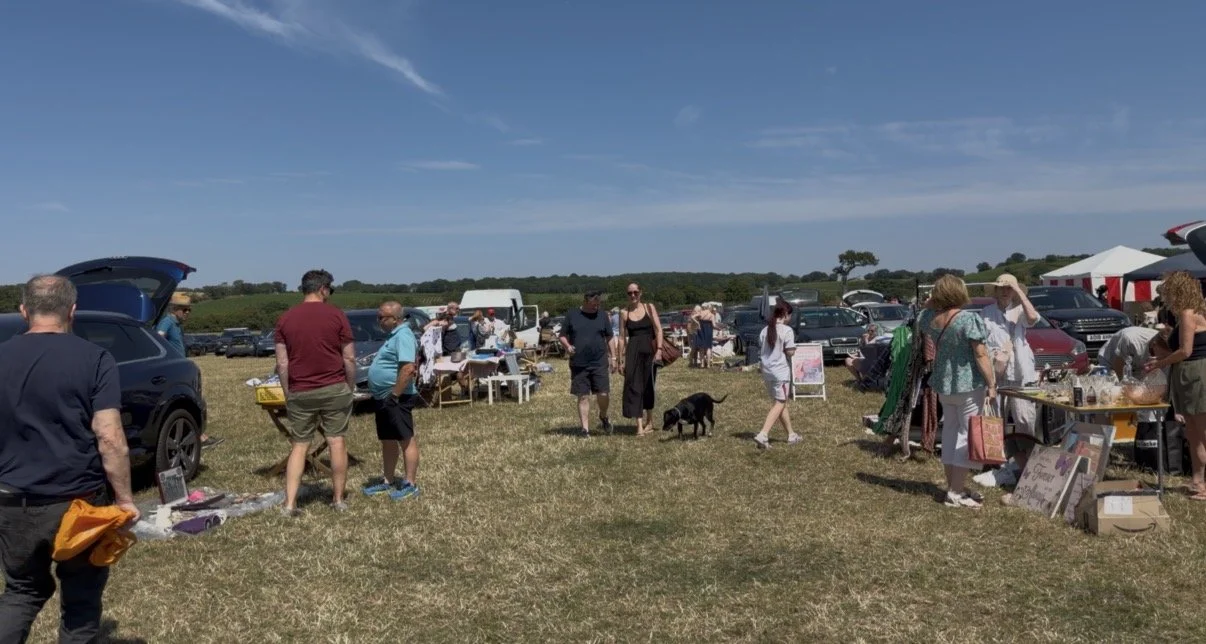
Our local bootsale
Now, if you've been following along, you'll know we're usually the ones buying at boot sales — we sell almost everything online. But once or twice a year we take a stall purely to have a clear-out: the little pieces from job lots that aren't worth posting, the things we bought ages ago and can't remember why, and — the classic — the enormous things we fell in love with and then got home and realised we couldn't ship. This year that was a gorgeous illustrated print of the doorway of the Natural History Museum. I saw it, I wanted it, I did not think it through. We've all been there.
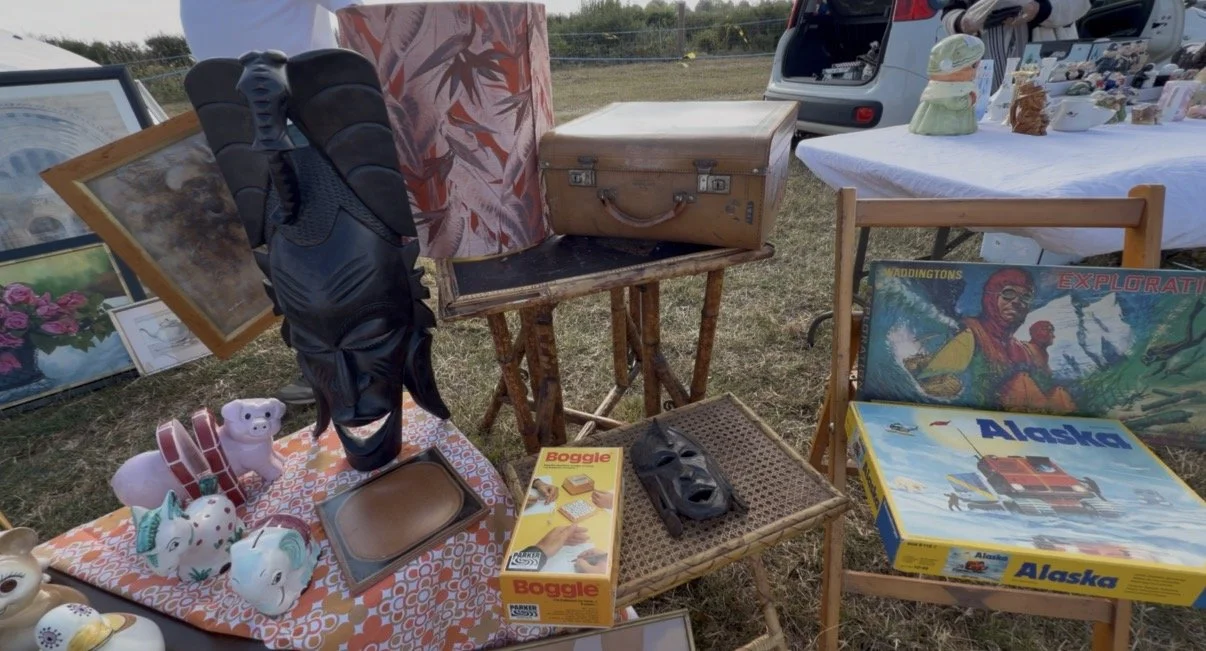
Mid-Century Ceramics and Bamboo Table on Our Stall
The best part of the day, though? People. When it's just the two of you working together all week, standing in a sunny field chatting to strangers about old things is genuinely good for the soul. We met a lovely couple doing up their house — he loves mid-century, she loves Victorian — and he won the battle that day, walking off with a tall mid-century lamp. (Between us, I was relieved. I did not fancy packing it.)
Try this yourself: if you buy vintage regularly, a little clear-out stall once or twice a year is a wonderful habit. It frees up space, funds your next hunt — and you get to send pieces off with people who'll love them.
The Finds of the Week — And Why We Picked Them Up
The Red Anglepoise Lamp — because some things you just great
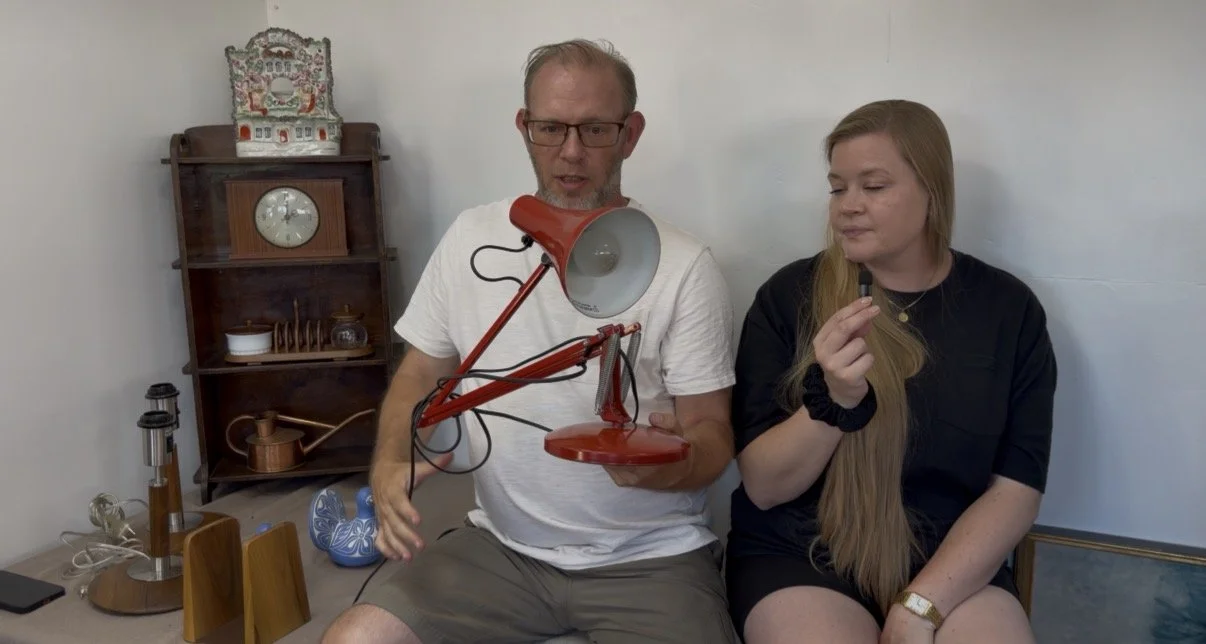
Vintage Red Anglepoise Lamp
This might be my proudest moment of the week, because I spotted it — and I'll be honest, I didn't fully know what I was looking at. I just saw a red lamp with beautiful bones and went for it.
It turned out to be an original Anglepoise, made in England, stamped on the base, in a glorious pillar-box red. If you don't know Anglepoise lamps, you'll recognise one the moment you see it — they're the classic British sprung task lamp, the design going right back to the 1930s (ours is a more retro 80s one). They were made for workshops and desks, so most of them have lived hard lives and turn up rusty and battered. This one hadn't. It still had its lovely old button switch.
We brought it home Sunday, listed it Monday, and it found its new home by Wednesday. Some pieces barely get to say hello.
Try this yourself: you don't always need to know exactly what something is to buy it. If the shape is beautiful, the condition is good and the price is small — trust the bones. Knowledge can catch up later. Mine did!
The Mid-Century German Bookends — because good design doesn't shout
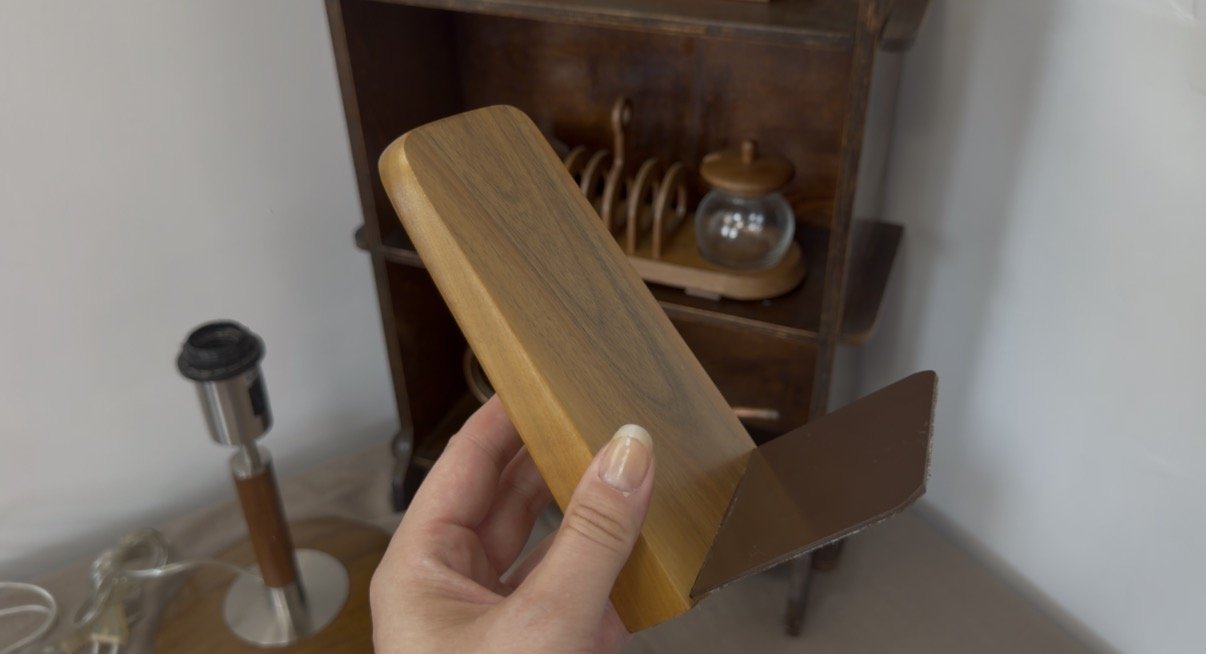
Mid-Century German Wooden Bookends
Brad's favourite from Kempton, and I understand why. A pair of mid-century German bookends: plain, simple, just a really beautiful piece of wood, chosen well and made well, with a little maker's logo. That was the whole point of mid-century modern — function first, no fuss — and these are that idea in miniature.
They came from a stall that was, hands down, the best at the whole fair. Not cheap — but priced right, which is a different thing entirely. When someone's stock is that carefully chosen, you're not just paying for the object; you're paying for their eye.
The Frandsen Danish Lamps — because style matters more than a date stamp
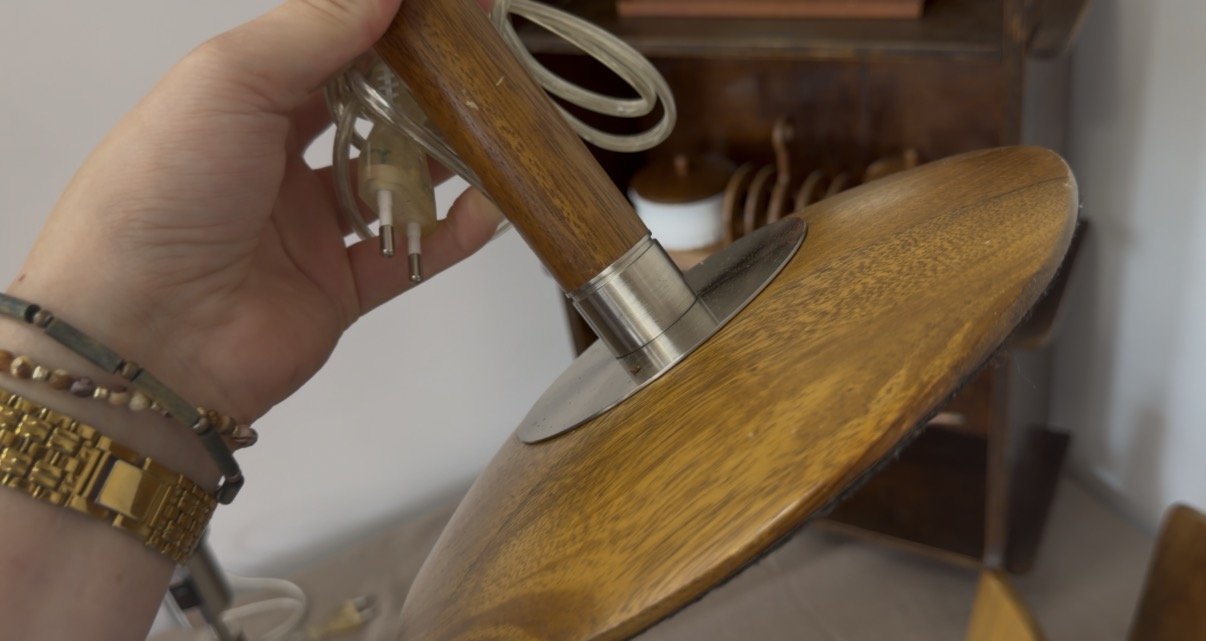
Frandsen Danish Teak and Chrome Lamps
Now, a little honesty about the pair of lamps I showed you last week. They're by Frandsen, a Danish company that specialises in lighting, in teak and chrome — you truly can't get more mid-century looking than that. But they're likely a bit newer than the 1950s.
And here's what I want to say to anyone who worries about this: it doesn't matter as much as you think. Yes, the dream is always the original pieces, because the older something is, the more stories it carries. But if you find the shape, the style and the colour you love, and it happens to be newer — enjoy it. Mix it in. Picture these two on either end of a long teak sideboard with the German bookends holding your art books in the middle. Nobody walks into that room and asks for paperwork.
Try this yourself: buy the look you love first, the date second. A newer piece in a style that sings to you beats an older piece you're lukewarm about, every single time.
The Signed Folk Art Pottery
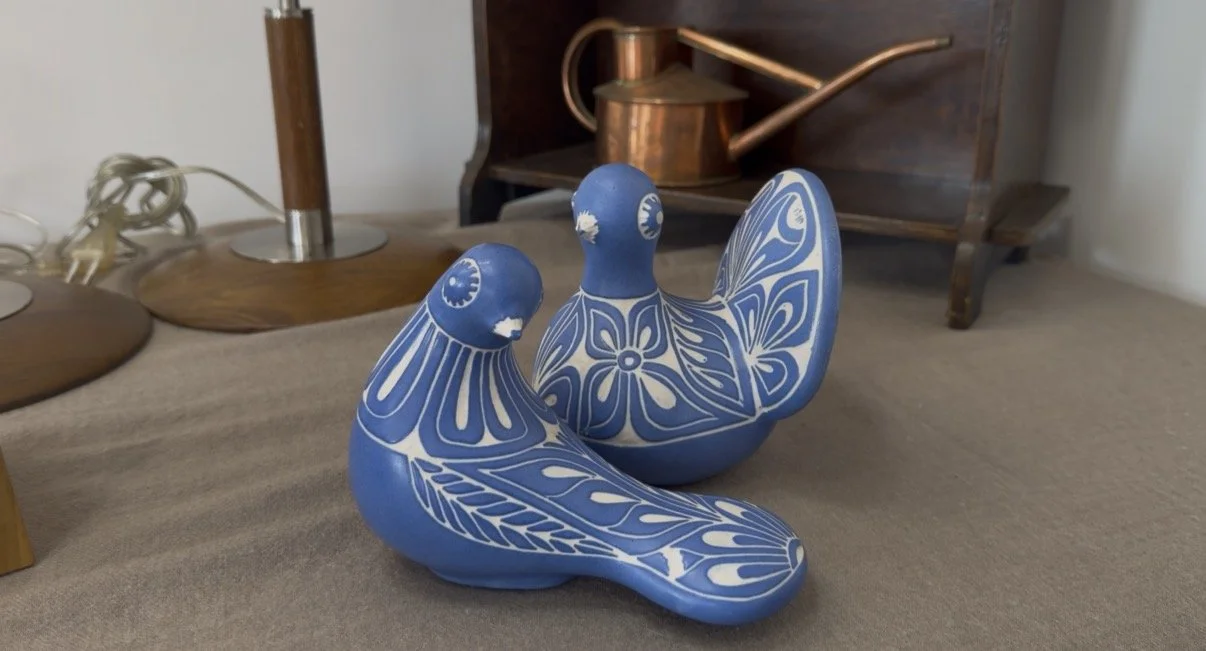
Signed Handmade Folk Art Pottery Birds
My favourite buy of the week, and no contest. A set of handmade pottery pieces with a proper folk art feel — signed by the artist, wonderful colours, and one of them has what I can only describe as funky eyeballs. I stopped, I smiled, I bought. You know my rule by now: joy is a complete reason, and signed, handmade pieces with that much personality are exactly what Fire and Wolf is about.
The Parrots That Got Away — because budgets exist for a reason
And now, the one I'm still thinking about. At Kempton we saw a pair of French gold-and-porcelain candlestick holders shaped as parrots, in blue and white. Absolutely stunning. We have never seen anything like them, and we may never again.
We didn't buy them. We'd gone to Kempton cautiously — first visit, tight budget — and they were priced well beyond what we'd allowed ourselves, even though Brad knew at a glance they were worth far more. And walking away was the right call and it stings. Both things are true.
Here's the honest lesson: at a big fair you have to hold your budget, because otherwise you'll blow the whole thing on one glorious item and go home with nothing else. But the pieces you walk away from teach you something too — they show you what your eye is really drawn to, and they tell you how to budget next time. The parrots are why we're going back to Kempton with a braver number in mind.
Try this yourself: when you walk away from something wonderful, don't just mourn it — make a note of it. The ones that got away are a map of your own taste.
Big News: We're Starting eBay Live Auctions
Now for the exciting bit. We've been invited to join eBay Live — live-streamed auctions where you can watch us present pieces in real time, ask questions, and bid as we go.
Honestly, this feels like such a natural fit for what we do. Vintage and antiques have always been sold at auction, and the thing I love most about live selling is what it gives you: instead of squinting at photos on a listing, you can ask us to measure something, turn it over, show you the base, hold it up so you can see the true size. It's the closest thing to standing at our stall without leaving your sofa.
Our first few shows will be relaxed clearance-style sales while we find our feet (Brad's only worry is the technology — "are we live? is it on?" — so do come for the finds and stay for the chaos). Then we've got proper themed shows planned: a mid-century show with pieces like the Frandsen lamps and the bookends, and an art show, because we have so many oil paintings, watercolours and prints, and being able to hold artwork up to the camera so you can see its real scale is going to be wonderful. Brad has decided we're aiming for Sotheby's. Give us a couple of weeks.
If you'd like to know when the first show goes live, subscribing to our YouTube channel is the best way to hear first.
What's Coming Next Week
Next Sunday we're doing something I've never done before: a village garage sale trail over at Tiptree — one of those days where a whole village opens up their driveways. I keep seeing people do these and they don't really happen near us, so I'm ridiculously excited. Boot sale in the morning, garage sales all afternoon. I'll show you everything I find (if anything!) in next week's roundup.
Before you go — a question, because we ended the video with it and I mean it: what did you find this week? If you picked up something that brought you joy — from a fair, a charity shop, your gran's attic — I would genuinely love to know. Tell us in the comments on the video. Watching people at Kempton walk past with wardrobes and chests of drawers was half the fun of the day; other people's finds are endlessly interesting to us.
And if you'd like first look at everything we bring home each week, join our founding members for 15% off for life at Fire and Wolf Interiors.
Frequently Asked Questions
-
An Anglepoise is the classic British sprung-arm task lamp, first designed in the 1930s and originally made for desks and workshops. Genuine ones are stamped on the base and were made in England. They're loved because the design is both beautiful and genuinely useful, and because they suit almost any interior — vintage examples in good condition, especially in strong colours like red, tend to sell very quickly.
-
No — and this worries people more than it should. Original 1950s and 60s pieces carry the most history and charm, but well-made newer pieces in the mid-century style, like Danish teak and chrome lamps, can look wonderful and mix happily with genuine vintage. Buy the shape, style and colour you love first; the date on the base matters far less than how the piece makes your room feel.
-
Yes, once or twice a year it's brilliant. A clear-out stall frees up space, moves the small pieces that aren't worth posting and the large pieces that are difficult to ship, and puts a little money back into your sourcing budget. It's also lovely simply meeting people — and pieces you can't sell online often find exactly the right home face to face.