

Our First Visit to Kempton Park Antiques Market: What We Found and Why We Picked It Up
Have you ever heard about an antiques fair over and over, kept saying "we really must go", and then... never gone? That was us with Kempton Park Antiques Market. One of our suppliers mentioned it, we put it on the list, and the list did what lists do.
Well — this week we finally went. Two hours on the M25 (the world's biggest car park), and honestly? Worth every minute. Brad and I came home with about twenty-five pieces, a head full of ideas, and one item we genuinely cannot identify. More on that later, because I need your help.

Kempton Antiques Market sourcing trip- was it worth it.
First Impressions: What Kempton Park Antiques Market Is Actually Like
If you've never been, Kempton is an antiques market held at Kempton Park Racecourse, just off junction 12 of the M25, and it runs roughly every two weeks all year round. It's hard standing rather than a muddy field, so a bit of drizzle won't cancel it — which, in England, matters.
Entry was wonderfully cheap. It's around £5 if you arrive at six for first pick, and by the time we rolled in (thank you, traffic) it was free. We've paid that to get into tiny boot sales. There are two car parks, stalls inside two buildings plus loads of outdoor sellers, and — this is the bit that knocked our socks off — mid-century pieces everywhere. Tables, chairs, sideboards, lamps. Things we normally hunt for months to find were just... in abundance.
My honest tip: if you've got a shopping list, or a very specific piece you've been searching for, Kempton is where you'll find it.
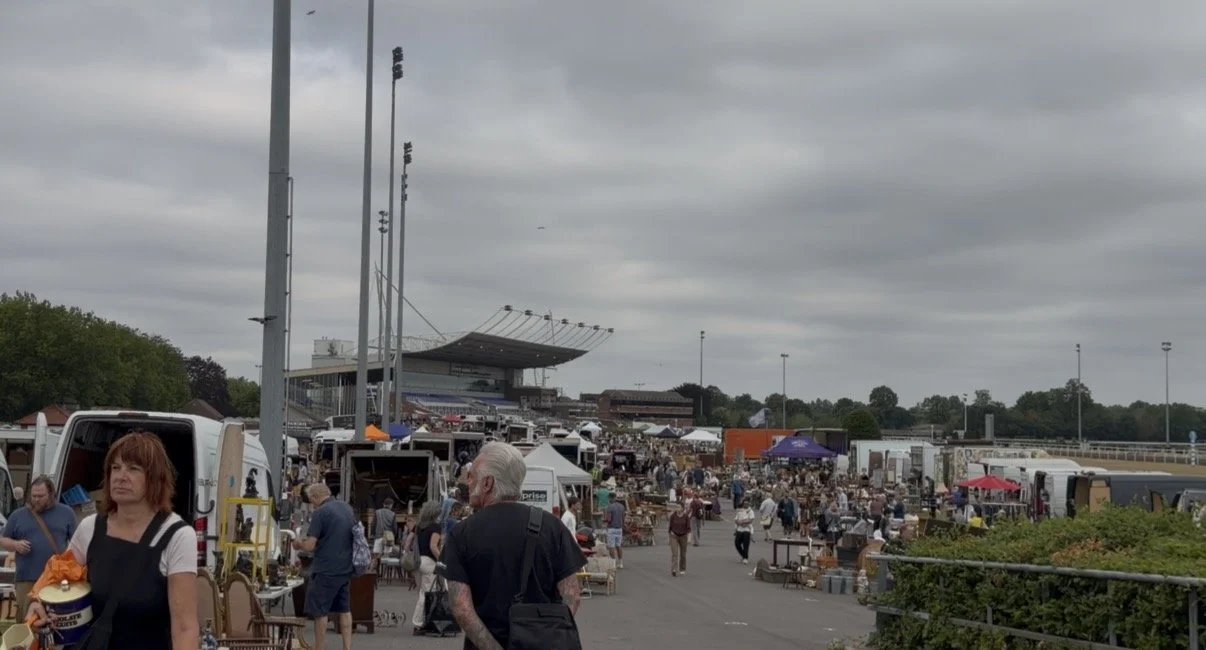
Kempton Race course antiques market
Why We Bought Cautiously (And Why That's Okay)
I'll be honest with you: we went in careful. It was our first visit, and at a fair that big it's so easy to get swept up — everything looks wonderful, everything seems reasonable, and you get home and realise you've overspent on things you don't quite love.
So we did the opposite. We kept the reins on, bought less than we wanted to, and yes — I'm still thinking about a few pieces that got away. But here's what I'd tell any nervous first-timer: being cautious on your first visit is not a failure. You're paying for knowledge. Now we know the layout, the sellers, the prices — and next time we'll go in braver.
Try this yourself: on your first visit anywhere new, give yourself permission to buy small and learn big. The fair will still be there next time. So will your confidence — and more of it.
The Finds — And Why Each One Stopped Me
The Handmade Wooden Stools — because simple things earn their keep
A pair of matching handmade stools in a lovely dark burgundy stain, held together with proper old flat screws. Nothing fancy, nothing rare — just honest, useful, made-by-hand pieces that belong in a kitchen, a garden, a potting shed, anywhere really. I'm drawn to things like this because they don't demand anything of a room. They just quietly make it warmer.
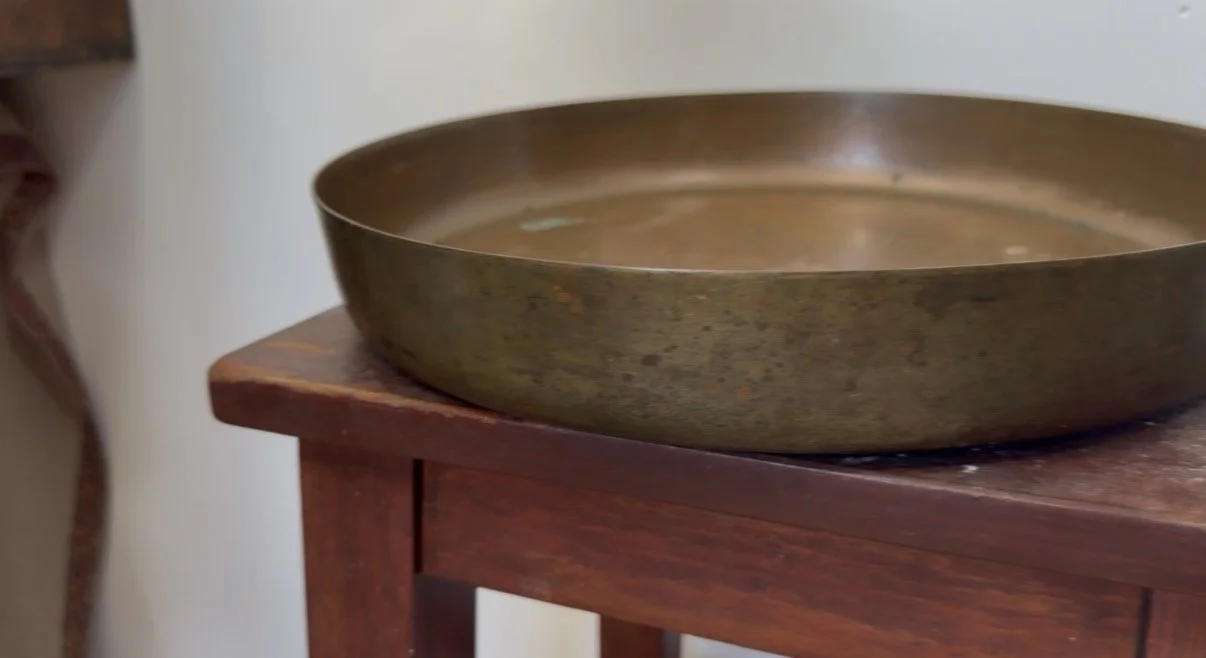
A beautiful copper display serving bowl
The Copper Bowl — because of one small detail
Brad slipped this into the trolley without me noticing (this happens more than you'd think). It's a good-sized copper bowl, lovely and weighty — but the detail that makes it is the higher lip around the side. Most bowls like this are quite flat; that little raised edge gives it presence. Fill it with candles at Christmas, fruit on the dining table, or nothing at all.
The Scottish Wool Blankets and Mohair Throw — because someone once loved them enough to name them
Yes, we bought blankets in a heatwave. (We're slowly building up stock for autumn — sourcing means thinking a season ahead!) One is pure wool, made in Scotland, proper tartan — and it has a name sewn into it: Anderson. You find that a lot with old textiles. People valued these things enough to label them as their own, and I find that genuinely moving. The mohair throw still has its label too — West of Scotland Home Industries — and another is hand knitted.
Try this yourself: with vintage textiles, always hunt for the label or a sewn-in name. It's the piece's little biography.
The Oak Caddy — because weight told me what it was
I picked this up expecting pine and my arm disagreed — it's heavy, which almost certainly means oak. A handmade carry caddy with a handle and a gentle curve along the top. Brushes, tools, kitchen bits, or just out on display. Tactile, handmade wooden pieces like this never hang around long, and I understand why: your hands want to pick them up.
The Hand-Painted Cottage Ornament — because charming is a category
This is a little hand-painted porcelain house with sheep, in the style of those Staffordshire flatback ornaments that once stood on Victorian mantelpieces. I've seen plenty of flatbacks — I've never seen one quite like this. It's quirky, it's pretty, and it made me smile. You know my rule by now: joy is a complete reason.
The Teak Toast Set — because breakfast deserves better
I thought this was Danish the moment I saw it — that clean mid-century teak look — but it's actually English. It's a toast rack with its own little pot for your butter or jam, and I just love the idea of someone laying this out for breakfast in 1965 and feeling terribly modern. Some pieces you buy because they make an ordinary morning feel like an occasion.
The Terence Conran style Lamp — because knowing the maker changes everything
Brad spotted this one, and I teased him that he "just liked the shape" — but no, he knew exactly what he was looking at. It's a Terence Conran desk lamp, originally sold through Habitat. There must have been forty lamps at Kempton that day, and this is the one he pulled out of the crowd. That's what years of looking does: the good one starts to glow at you
Try this yourself: pick one designer or maker you love and learn to recognise their work on sight. It turns every crowded table into a treasure hunt with a prize hidden in it.
The Little Milk Churn — because it looks like a summer cottage in Finland
I am forever hunting for pieces that look like they've come from a Nordic summer cottage, and this small milk churn is exactly that. Chipped paint, proper patina, a curious rounded base — it looks used, in the best way. Hang it in a kitchen with dried flowers in it and tell me it doesn't make you happy.
Try this yourself: chipped paint and wear aren't flaws on a piece like this — they're the evidence of a life. If it still makes your heart lift, the patina is a feature.
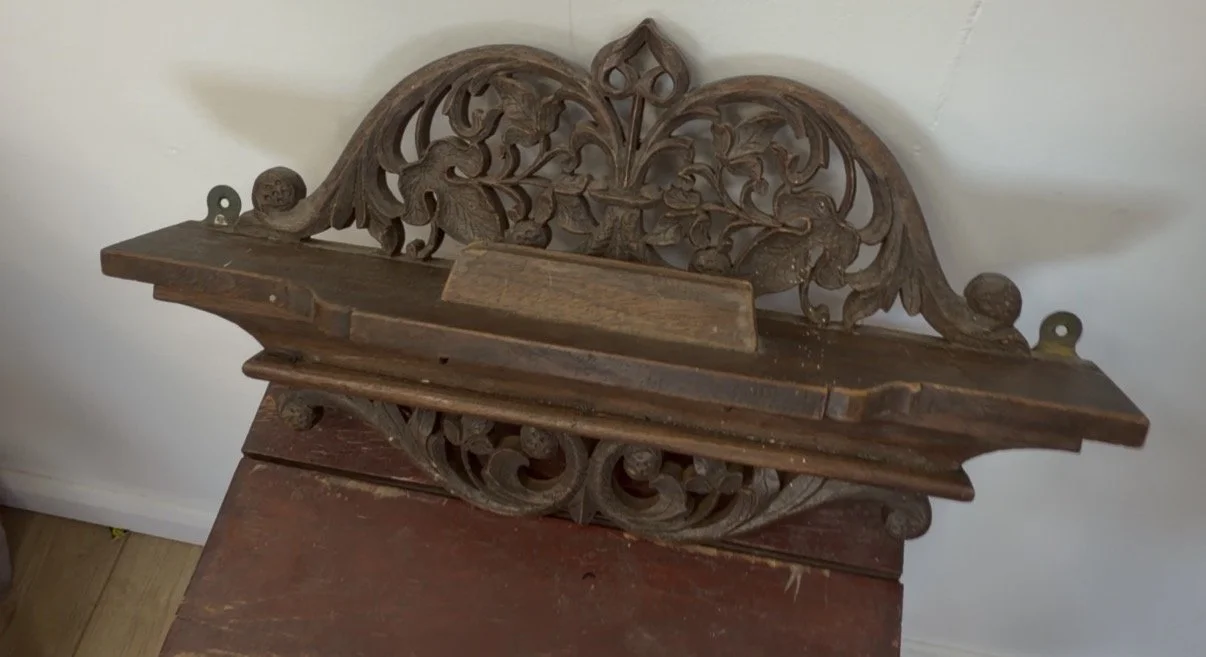
Mystery Antique Hand-Carved Wooden Shelf
The Mystery Shelf — because we still don't know what it is (help!)
Right — this is where I need you. We bought a beautifully hand-carved wooden shelf with real age to it. It has little hooks underneath and a small ridge that looks like it would hold... a pen? A cigarette? We genuinely don't know. It might be the world's fanciest pen holder. If you know what it is, please tell us — leave a comment on the video. Fifteen years in, and we still learn something every single time we go out. That's not a confession, it's the best part.
The Victorian Corner Shelf — because age is the cheapest way to add character
A dear little handmade Victorian corner shelf, needing nothing but a clean. Pieces like this are one of the most affordable ways to change a room: the moment you add something with genuine age to a corner, the whole space warms up around it.
The Pair of Victorian Vases — because pairs almost never survive
We hardly ever buy Victorian vases, and here's why: they're nearly always damaged, or they're singles. A surviving pair, hand-painted, in a colour we rarely see, with no chips or cracks — just a gentle crackle to the glaze that comes with age? I couldn't quite believe it. When something has beaten the odds for a hundred and fifty years, that alone is a reason to stop.
Try this yourself: run your fingertip slowly around the rim and base of any ceramic piece. Your finger will catch a chip your eye misses every time.
The German Bookends — because good design needs no decoration
A simple pair of mid-century German bookends with the most beautiful grain in the wood. Nothing added, nothing showy — just proportion and material doing all the work. The lady whose stall these came from had, hands down, the best stand at the whole fair, and I could have bought everything on it. (There was a wool wall plaque I'm still dreaming about.)
The Handmade Pair from Chile — because I'd never seen anything like them
These two might be my favourites. A pair of handmade, hand-signed ceramic animals — blue and white, folkloric, with a look I'd have sworn was Scandinavian. Turn them over: they're from Chile. We've had French pieces, Danish pieces, English pieces galore — never anything from South America. They're a pair without being identical, which I find so charming, and if they don't sell I will not be even slightly sad when they appear in our living room.
The Danish style Lamps — because some things whisper "keep me"
And finally, the pair I'm quietly desperate to keep: matching mid-century lamps, European plug, a maker's name on the base we're still researching. I can already see them either side of a bed on mid-century side tables, or standing at each end of a long teak sideboard. Here's our honest problem: we've just moved house, we're doing it up, and every beautiful thing we source now comes with a little voice saying "...or we could keep it." If you do what we do, you know this struggle intimately.
Our Honest Verdict on Kempton — and What's Next
Would we go back? In a heartbeat. Cheap entry, lovely sellers, easy to reach, all-weather, and more mid-century in one place than we've seen anywhere. We're planning to return every month or six weeks, and we've got Newark Antiques Fair in August and Shepton Flea in September on the calendar too — so subscribe to the YouTube channel if you'd like to come along.
One more thing before you go. If you're hunting for something specific and can't find it — tell us. We're out sourcing constantly, and we're already keeping our eyes peeled for a few lovely people: suede lampshades for one, particular lamps for another. It's honestly one of our favourite parts of what we do. Drop us a message through the website.
And if you'd like first pick of everything we bring home — including, possibly, those Chilean pair if I can bear to part with them — join our founding members for 15% off for life.
Frequently Asked Questions
-
Yes — in our experience it's outstanding, especially for mid-century furniture, lamps and ceramics. It's held at Kempton Park Racecourse just off junction 12 of the M25, entry is inexpensive, the sellers are friendly, and the variety is far bigger than a typical antiques fair, with stalls both indoors and outdoors. If you have a specific piece on your wish list, this is the kind of fair where you'll actually find it.
-
Kempton Park Antiques Market runs roughly every two weeks, all year round — you can check upcoming dates on the official Sunbury Antiques website. Because the site is hard standing rather than grass, it isn't cancelled by wet weather the way field-based fairs often are, so don't be put off by a bit of drizzle.
-
Decide your budget before you arrive and decide whether you're browsing or shopping from a list. Big fairs are exciting, and it's easy to get swept up and buy things you don't truly love. On a first visit, it's perfectly fine to buy less and treat the day as a scouting trip — you'll come back knowing the layout, the sellers and the prices, and you'll buy with far more confidence.
-
Check condition with your hands as well as your eyes. Run a fingertip around the rim and base to feel for chips and cracks, and look for hand-painted detail and a maker's signature underneath. A fine crackle in the glaze is normal on older pieces and simply comes with age. And if you find a genuine matching pair in good condition, take it seriously — pairs rarely survive intact.
-
Yes, and larger fairs are one of the best places to look. Mid-century tables, sideboards, lamps and ceramics that can take months to find individually often appear in abundance at big regular markets like Kempton Park. Learn to recognise a few makers and designers you love — like Terence Conran pieces made for Habitat — and you'll start spotting the special pieces among the crowd.